

On February 18, 2025, the White House issued an Executive Order aiming to lower costs and reduce barriers to IVF, opening a 90-day window during which the Assistant to the President for Domestic Policy submitted policy recommendations to the president. Being a leading voice in this space, RESOLVE advocated for policies which best serve IVF families and want to support their policy recommendations with the voices and lived experiences of IVF patients. To do this, an online survey fielded on Monday, April 7, 2025, to 1,814 individuals who were exploring, considering, undergoing, or who had undergone fertility preservation/treatments.
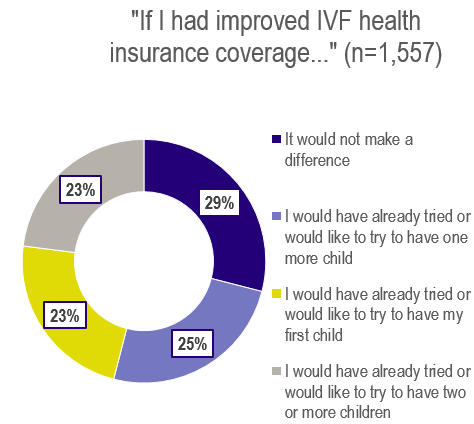
Currently, slightly more than one-half of patients (53%) have some form of IVF covered by their health insurance. For seven in ten (71%) patients, better IVF health insurance coverage would have changed the trajectory of their family planning.
To better understand patient priorities around IVF, the study forced patients to choose between a series of paired hypothetical health insurance coverage options. Interestingly, insurance covereage was not unilaterally chosen, highlighting the importance of recognizing and appreciating patents’ unique positions, beliefs, and challenges. For example, if forced to choose, four in five (80%) would want IVF to be covered by health insurance and, in exchange for this, would relinquish the ability to receive any information about the embryos before transferring them, such as sex and physical features, like eye color, while roughly three-quarters (77%) of patients would rather not have any IVF health insurance coverage and retain full rights and decision-making power over their frozen embryos. Patients are divided on giving up genetic testing in exchange for IVF health coverage (51%, no IVF health coverage but genetic testing allowed, compared to 49%, IVF covered through health insurance, but no genetic testing on embryos allowed).
However, the survey findings revealed an opportunity to improve the lives of some patients with lower costs to insurance companies which have nothing to do with IVF. The average female patient was 34 before she was diagnosed with infertility and the average male patient received this diagnosis at 36 years of age. Had they been diagnosed at an earlier age, seven in ten (72%) would have started their IVF journey sooner, one-half (49%) would have undergone treatment or surgery addressing the root cause of infertility, and one-quarter (25%) would have explored adoption. Therefore, before IVF even needs to be a consideration, insurance should cover screenings for patients wanting to have biological children far earlier than when they try to conceive. Doctors should be aware of this need for early screening and proactively discuss this with their patients. Patients should be advocating for early fertility screenings if they know they want to have biological children in the future. By identifying and diagnosing root causes of infertility early, patients and doctors may take different approaches to interventions and family building decisions, likely reducing the overall need for IVF.